Erratic availability of diesel has crippled the economy, frustrating hauler’s efforts to meet agricultural inputs delivery deadlines and pushed up the cost of doing business across the sectors, The Nation has learnt.
In an interview yesterday, Malawi Confederation of Chambers of Commerce and Industry (MCCCI) director of business environment Lucky Mfungwe said while the transport and logistics sector has been hit hardest, manufacturing, services and small and medium enterprises (SMEs) sectors have not been spared either.
He said with diesel accounting for nearly 50 percent of operating costs for haulage companies, long queues at service stations and high fuel prices, now at K3 500 per litre, have pushed up freight charges, directly affecting the cost of goods and services.
In the manufacturing sector, he said frequent fuel shortages and power outages have led to production delays and reduced output as many factories rely on diesel-powered generators due to load-shedding, making operations more expensive as fuel cost has soared.
Said Mfungwe: “The diesel scarcity and price surge have increased transportation and production costs, disrupted supply chains and intensified inflationary pressures [thereby] creating significant uncertainty and eroding business profitability for businesses.
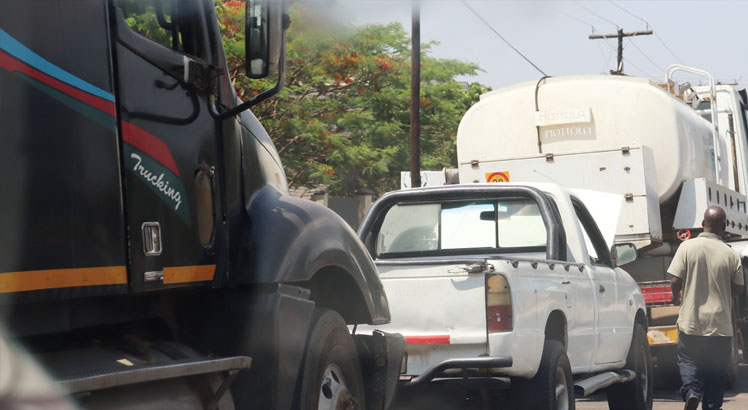
in Blantyre. | Francis Chamasowa
“For small and medium enterprises, which form the backbone of Malawi’s economy, the crisis is translating to thinner profit margins, planning difficulties and, in some cases, temporary closures due to high operating costs and unpredictable supply.”
Already, businesses are still failing to fully utilise their installed productive capacity largely due to continued foreign exchange scarcity, high inflation and rising costs of inputs.
MCCCI Business Climate Survey for the first half of this year showed that only 11.1 percent of businesses reported utilisation rate of above 75 percent while 51.9 percent of the firms reported a capacity utilisation of below 50 percent, with 37 percent reporting a utilisation rate of higher than 50 percent, but lower than 75 percent, which is the recommended industry threshold.
In a separate interview, Malawi Union of Small and Medium Enterprises newly-elected president James Chiutsi observed that the scarcity, apart from the direct costs, is leading to several idle hours in production, forcing employers to pay for non-productive hours too.
Transporters Association of Malawi spokesperson Frank Banda said while the situation is mostly dire in the Southern and Northern regions, most transporters are affected as it is during this time of the year that they mostly transport fertiliser and some agricultural inputs, especially to rural areas.
On his part, Road Transport Operators Association of Malawi executive director Chrissie Flao observed that while the delays in waiting for fuel could become crippling if they persist, they believe the situation will improve.
“It’s still early days with the new government, but there’s renewed hope that supply will start improving and the situation should ease by next week,” she said.
One of the truck drivers Christopher Mahata, who was found on a queue at Petroda Kameza Service Station in Blantyre, said he had spent three days without doing business.
Speaking separately, Ministry of Energy Principal Secretary Engineer Emmanuel Matapa indicated that government, through National Oil Company of Malawi (Nocma) “is working tirelessly to normalise the situation”.
He said six fuel trucks have been dispatched around Blantyre while an additional volume will also be distributed through privately-owned Petroleum Importers Limited (PIL); hence, “we expect normalisation by tomorrow or Friday”.
PIL general manager Martin Msimuko declined to comment, referring the matter to Malawi Energy and Regulatory Authority (Mera).
On her part, Mera spokesperson Fitina Khonje acknowledged the fuel scarcity, attributing it to a mismatch in the rate of the products’ arrival into the country and the demand.
Meanwhile, the Malawi Government is in the process of increasing the capacity of strategic fuel reserves from the current 60 million litres to 120 million litres.